The AI Workflow Stack That Runs Caydev
We may have taken our obsession with AI Agents a little too far. Here's what we use, what we cut, and what we built ourselves.
Leonard
Leonard is Director and Builder at Caydev.

When I went through our monthly spend recently, what surprised me was how small our paid stack actually is. Across consulting and multiple products, the visible line items are short. What keeps it that way is that the part doing the real work doesn't show up on any invoice.
We call that part our Agentic Business Operations. (Yes, we're coining this term). It isn't one tool. It's the layer of agents, workflows, and shared memory we built on top of the tools we do pay for.
What we pay for
Here is the honest list, grouped by what each line item does.
Build. Claude Max is unmatched value at $100 a month for daily writing, design, and code. Cursor at $20 is our IDE of choice and the market leader for a reason. CodeRabbit is the little secret tool that does a good-enough review of every commit before it ships. The Anthropic API picks up usage spikes on top of that, usually another $30 to $50. Roughly $200 buys us a software engineer's worth of throughput.
Data and research. Supabase at $65 for our databases. Firecrawl has proven critical for web scraping and processing, at $19 for structured web extraction. None of these is expensive on its own, and none of them is negotiable.
Then there are the free tiers, which carry more weight than people realise. Vercel hosts our sites on a generous free tier. Postiz runs our social media scheduling, fully self-hosted at no cost. n8n is the power train behind most of our workflows, also self-hosted. Any time we see a strong solution with a free, self-hosted option, we get excited.
That is roughly the floor of running this kind of business in 2026, and it is also where most of the conversation about AI tools stops. The businesses I see growing are the ones that built something the stack alone could not give them.
What we built on top: here come the agents
About a year ago, we got tired of repeating the same kinds of work: pulling a sales summary every morning, reconciling expenses every Friday, and drafting the same five social posts every week. One thing most entrepreneurs underestimate is how much marketing it actually takes to grow a business. We spend hours every week writing content, producing creatives, and publishing across social channels. So we started building small agents, one for each kind of work, and gave them access to the same systems we use ourselves.
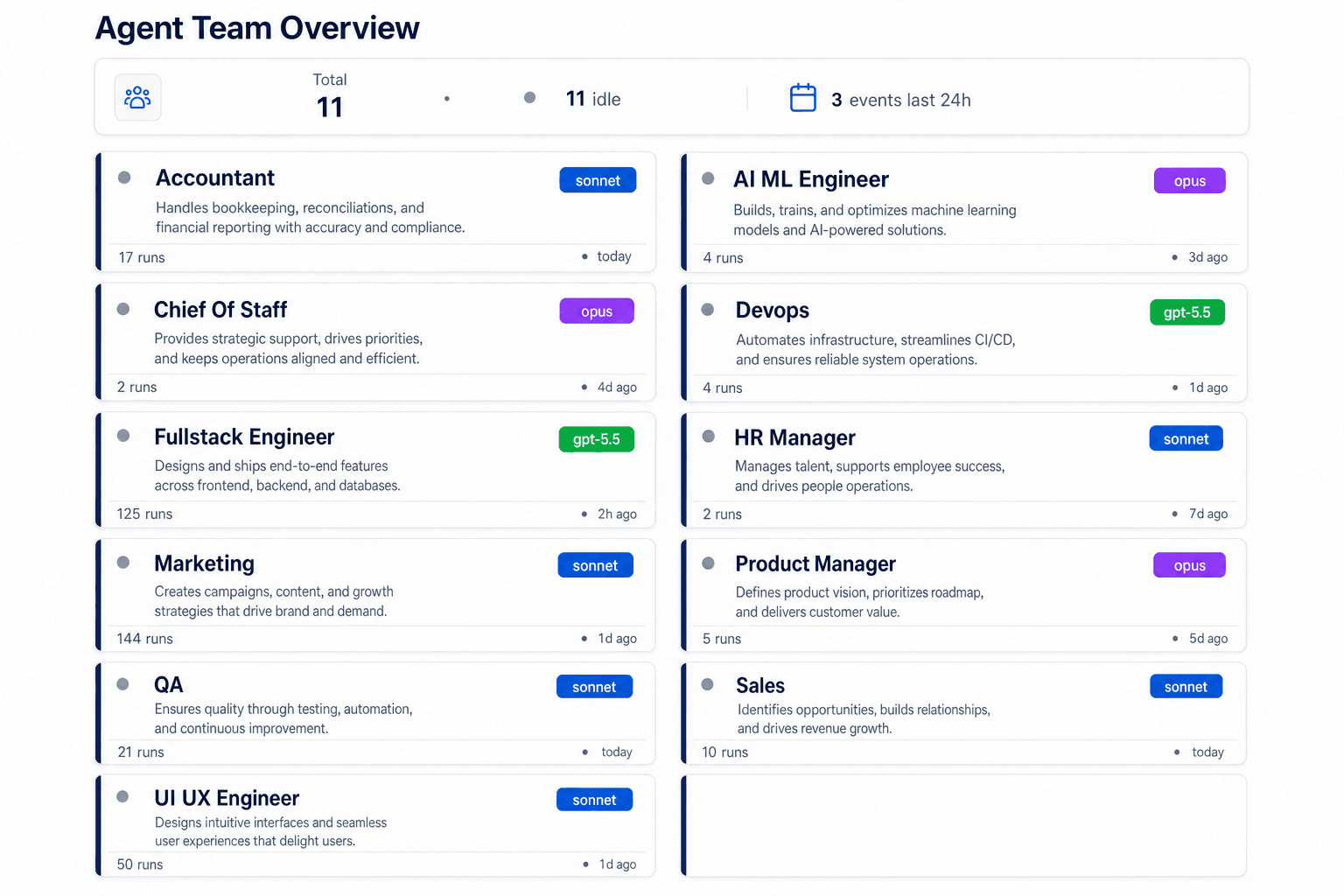
What grew out of that is what we now call our Agentic Business Operations. It is a set of specialist AI agents covering sales, marketing, accounting, design, engineering, QA, product, AI, and operations, each with a clear output contract that says what it produced, how to verify it, what it could not figure out, and what to do next. A coordinating router decides which one handles a given task. Behind them sits a shared knowledge layer, the memory, built on our internal vault (Obsidian for the win), so every agent works from the same set of facts about the business.
Some of those agents run on a daily heartbeat. Sales scans the CRM every morning and surfaces what changed overnight. Giving it access to email so it can see the correspondence with leads and clients turned out to be the unlock. Marketing scans social channels and competitor activity daily. The accountant runs three times a week and flags anything off-pattern in our spend or invoicing. None of this is asked for. It just arrives. The cost of building this was time, not money.
What we cut
The list of what we removed taught us as much as the list of what we kept.
Duplicate tools. We were paying for two coding assistants that did the same job, and our vendor intelligence app (SaveMySaaS) flagged the overlap. We recovered $180 a year.
Paying for tools where we used less than half of the features. We were subscribed to platforms for SEO and web analysis, but we only needed the SEO data, not everything bolted on around it. Those subscriptions were expensive. Switching to a service that provides the raw data so we can process it internally has been invaluable.
Generic content. Every piece of AI-written content we published without a deliberate distribution plan generated nothing. Producing faster does not matter if no one is reading.
Three rules we keep
AI executes, humans decide. Use it for first drafts, summaries, structured extractions, and repeatable production. Keep judgment, taste, and final approval with a person.
Every agent has an output contract. Whatever it produces, it should also tell you how to verify it, what it could not figure out, and what to do next.
Self-host the leverage, rent the commodity. The LLMs are too big to run on your own devices (we learnt this the hard way). Until smaller models catch up, we lean on the cloud ones; Anthropic, OpenAI, and Google do that better than you ever will. But your customer data, your operational memory, and your reporting layer belong on infrastructure you control.
The point
None of this started as a stack. It started as one repeating task we got tired of doing, then another, then another. Six months in, what we had built was a quiet system that holds the operating memory of the business and frees us to spend our days on the work that needs our experience, judgement, and taste.
So the question is not whether your business needs more tools. It is which part of your business would you stop running by hand if a system could hold it for you?
If you want to map that out for your own operation, that is the conversation we have on a consult.